
Here’s the latest edition of my regular series of Quick and Easy Health, Physique Transformation and Sports Conditioning tips.
You can put these into action right now to Look, Feel, Move and Perform better.
These tips are organised into 3 different categories:
- General Health & Motivation
- Training (Fat Loss, Muscle Gain, Athleticism & Strength)
- Nutrition
Enjoy!
General Health & Motivation
‘Do your calves cramp during sports or running? Fix your back and get your core and glutes firing.’
In a recently published study in the Journal of Strength and Conditioning Research, a history of lower back pain predicted calf cramping in professional rugby players.
Crazy calf cramps are something I’ve experienced myself on a couple of occasions during matches in the past – reading this study got me thinking…
- Many rugby players (and plenty of other sportsmen/women) are in heavily extended postures with anterior pelvic tilts and excessive lumbar lordosis (see picture below – translation – among other things, tight hips and poor core control cause a big arch in the lower back).
- Athletes in these postures struggle to effectively use their glutes to extend at the hip (a key function in running/sprinting).
- If you can’t use your glutes properly to extend your hip during sprinting, you’ll have to acquire the motion elsewhere – and that likely means extra push-off at the lower extremity: plantarflexion (translation – the squeeze you feel in your calf as you push your toes further away from your shins).
- Your calves are plantarflexors – hence why they cramp in the conditions above.
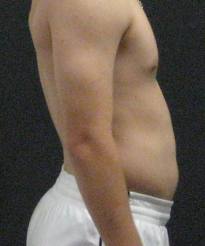
So, the way my simple mind sees it – if you lose your glute strength and anterior core control, you’re likely to overuse and cramp your calves when running, especially in conditions of fatigue.
It’s just a theory, and I’d be very interested to see if calf cramping was also predicted by postural assessments at the lumbo-pelvic (low back/hip) region.
In the meantime, here’s my advice if you’re getting calf cramps when you compete.
Fix your lower back posture by getting your glutes and anterior core firing properly.
Adding a dedicated sequence of Hip Flexor Mobilisations -> Glute Bridges -> Deadbugs to your warm-up would be a great starting point.
Training (Fat Loss, Muscle Gain, Athleticism & Strength)
‘Stop considering a week to be seven days long’
Most programs are based on a 7-day week.
I get it – the rest of the world works on a Mon – Sun format, so logic says your training should, too.
Doing so leads to a few different ways to split up a training program; the common choices are 3–5 days of training with 2–4 days of rest or supplemental activity.
Don’t get me wrong; this is fine, and it certainly works – it’s how lots of my programming is set up.
However, consider this – your body doesn’t know what a week is; it has no idea a week is seven days long.
Therefore, you should consider writing/following exercise programs in the optimal format for the results you are looking to achieve.
Viewing a ‘training week’ as however long you want gives you the opportunity to meet more demands while still allowing for optimal recovery. Or, it can be used to hit certain lifts or body parts more often while still addressing other lifts or body parts that may require more time between training sessions to get rest. Here’s an example:
Traditional 4-Day Training Split (with additional Movement Training)
Monday: Lower Body
Tuesday: Upper Body
Wednesday: Movement Training
Thursday: Lower Body
Friday: Upper Body
Saturday: Movement Training
Sunday: Off
‘Spread Out’ Split
Day 1: Lower Body – Squat
Day 2: Upper Body 1
Day 3: Movement
Day 4: Off
Day 5: Lower Body – Accessory Work
Day 6: Upper Body 2
Day 7: Movement
Day 8: Lower/Full Body – Deadlift
Day 9: Off
By spreading the ‘training week’ out, a few things happen.
- You get an extra day of training to address weaknesses, or to just spread out some of the exercises from the previous model into a fifth day.
- You’ll have more total days off to recover in the course of a year, as the first model gives you one day off every 7 days, and the second model gives you 2 days off for every 9. You have more days off before hitting certain lifts again, which can allow for better recovery between sessions.
Don’t get me wrong – 7-day models work just fine.
I simply want to challenge you to think outside of the 7-day mindset; it allows you to do some good, different things with your training.
Following on from my featured article in yesterday’s Top Fitness Articles You Should Read, spreading your ‘training week’ out also means you don’t have to start each week on a Monday (avoiding the ‘Monday Mindset’ trap) and also allows you train over the weekend in some cases – a time where many people notoriously slip up with their program.
Nutrition
‘Prioritise adherence for nutritional success’
This is not revolutionary, nor does it apply solely to nutrition.
If you want to be successful, prioritise adherence.
If I asked a handful of people what the top priority would be to help someone improve their nutrition, they would likely go for a number of things; follow a plan, eat real food, cut out the junk, etc etc.
All very valid, but none hit the top of the priority list.
I think nutrition success is often limited by the person, not by the information.
The information is there; it’s everywhere (of course, finding the right information is another thing). The reason changes aren’t being made has more to do with the person (or with YOU), and the ability to be consistent.
If I were to choose one thing to prioritise in a nutrition plan, it would be adherence.
Adherence is your ability to stay the course, or stick to the plan.
Make changes slowly, and choose things to which you know you can adhere.
Pick ONE THING to improve – do that well – then do another, and so on.
Over time, the improvement will be profound. You’ll be far more likely to succeed than trying to go immediately from where you are now, to an all-encompassing nutrition plan that requires you make a number of radical changes in one go.
I hope you’ve enjoyed the latest edition of my regular series and found it useful.
Thanks for reading and please do share with anyone else you know will benefit!
Feel free to post some of your own ideas in the comments section below and on RHP’s Facebook or Twitter pages, too!
Rich
P.S. – to access every installment of my regular ‘Quick and Easy Ways to Look, Feel & Perform Better’ series, click here.


Leave a reply